
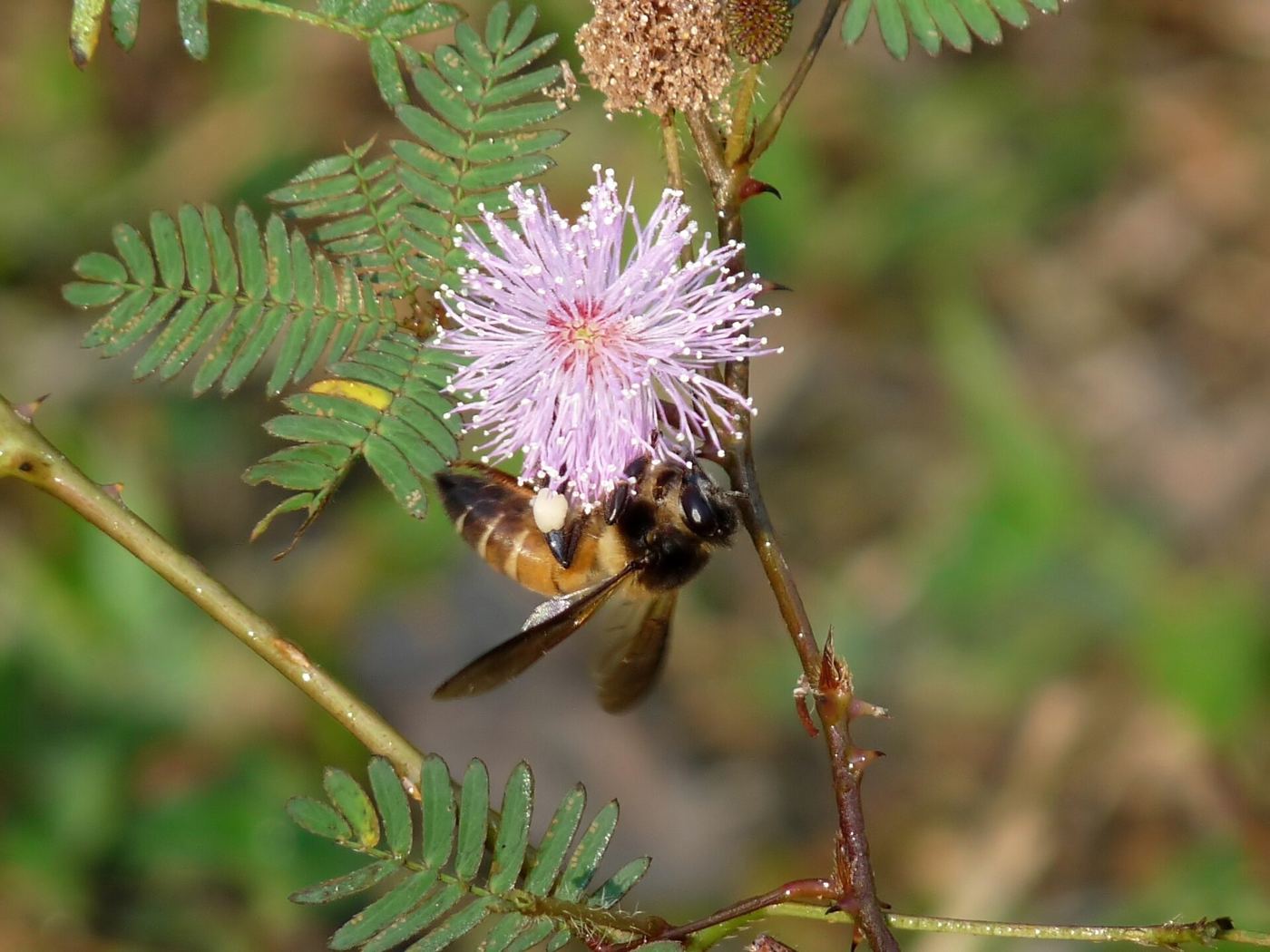
Flowers advertise themselves with colour, scent and shape, but biologists have established that they also broadcast in a channel humans cannot perceive at all: electric fields. As a bee flies, friction with the air builds a positive charge on its body, while a flower connected to the earth carries a slight negative charge, and the interaction between the two distorts the flower’s electric field in ways the insect can detect through fine hairs that bend in response. Experiments show that bees learn these electric patterns alongside colours, using them to judge which flowers they have recently visited, because a drained flower’s field changes after a visit. The discovery has widened scientists’ understanding of pollination into a sensory world of signals exchanged at close range, invisible to us yet apparently routine for the insects on which a third of food crops depend. It also raises questions about how pollution and pesticides might interfere with such delicate electrical communication.
What the Evidence Shows
Follow-up research is examining how widespread electric field sensing is among pollinators and other animals. Hoverflies, butterflies and even spiders appear to respond to electrical cues, with spiders possibly using atmospheric fields to decide when to release silk threads and balloon away on the wind. Air pollution has emerged as a serious complication: charged particles and chemical contaminants can alter floral electric fields and degrade the scent plumes insects follow, effectively jamming two signalling systems at once. Conservation biologists argue this strengthens the case for reducing pollution around farmland and wildflower habitat, beyond the direct toxicity of the chemicals involved. Engineers, characteristically, see opportunity in the biology, prototyping tiny sensors inspired by insect hairs for detecting weak electric fields in medicine and robotics. The field’s rapid growth illustrates how a curious observation, that bees and flowers exchange charge, can reorganise understanding across ecology, evolution and technology within little more than a decade of focused research attention. Reporting and analysis from sources such as NASA track the same developments, and specialists following electric field sensing by pollinating insects say the direction is now consistent across independent lines of evidence.
The Wider Context
Funding bodies are watching electric field sensing by pollinating insects closely because the work sits at the junction of basic curiosity and practical return. Grant panels increasingly ask for a path from discovery to application, while researchers push back that the most valuable uses of fundamental science are rarely the ones written into the original proposal. The tension is productive when both sides stay honest about timescales.
What Happens Next
The long view on electric field sensing by pollinating insects is that fields advance by accumulation rather than by single announcements. This result adds a solid, checkable piece to a structure many teams are building, and its authors have shared their data so the piece can be tested from every side. That is how the picture eventually becomes reliable enough to act on. You can follow related developments in our coverage of science.
It is also worth remembering how quickly the picture in this area has changed before. Positions that looked settled a few years ago have been revised as new data arrived, and the same humility is appropriate now. The strongest coverage of this subject, and the most useful advice, tends to come from sources that update their views openly when the facts move, rather than defending an earlier position long after it has stopped fitting the evidence available.

